Conversational AI has moved far beyond simple chat widgets. Today, businesses use it to sell more, support customers faster, onboard employees, and even help clinicians and teachers. When done well, it feels natural for users and quietly drives measurable results in the background, enhancing the overall digital customer experience while enabling smarter call centers through AI.
This guide walks through 10 practical, real-world conversational AI examples, what they do, and the benefits they deliver. Use these ideas as inspiration for your own roadmap.
Large-scale AI applications rely on robust infrastructure capable of handling intensive computations. Leveraging high-capacity distributed computing networks allows organizations to deploy AI models efficiently while ensuring minimal latency for real-time user interactions. These systems provide the backbone for conversational AI to operate seamlessly at scale.
Understanding the mechanics of advanced processing clusters for AI workloads is crucial for organizations that want to implement AI solutions capable of complex predictive tasks. With these high-performance setups, natural language processing engines and machine learning models can deliver faster, more accurate results, improving the overall efficiency of customer support systems.
Optimizing digital engagement strategies requires intelligent data-driven interaction systems that analyze user behavior across multiple touchpoints. By using these insights, organizations can design conversational flows that are intuitive, personalized, and aligned with the user’s journey, enhancing satisfaction and retention.
For internal operations, workflow automation powered by AI helps companies reduce manual workloads while maintaining consistency in customer communications. By automating repetitive tasks, human teams are freed to focus on strategic initiatives, while AI ensures that every interaction remains timely and relevant.
Financial and operational efficiency benefits from predictive enterprise analytics, where AI analyzes historical data to forecast trends, optimize resource allocation, and reduce operational risks. When paired with conversational AI, these analytics enable more informed decision-making and create a smoother experience for both employees and customers.
By reviewing these practical conversational AI examples, businesses can understand how modern AI infrastructure, predictive analytics, and intelligent workflow automation work together to enhance operational performance. From reducing response times in customer support to improving digital engagement, the right combination of technology and strategy allows enterprises to stay competitive in today’s fast-paced environment.
Top 10 AI Contact Center Solutions: Conversational AI Examples for Modern Businesses
Businesses today are adopting AI-powered contact center solutions to improve customer interactions, reduce response times, and enhance overall satisfaction. Implementing advanced platforms allows organizations to scale efficiently while providing personalized support. Here are 10 leading solutions that showcase practical conversational AI examples in action.
1. Bright Pattern: AI Contact Center Solutions
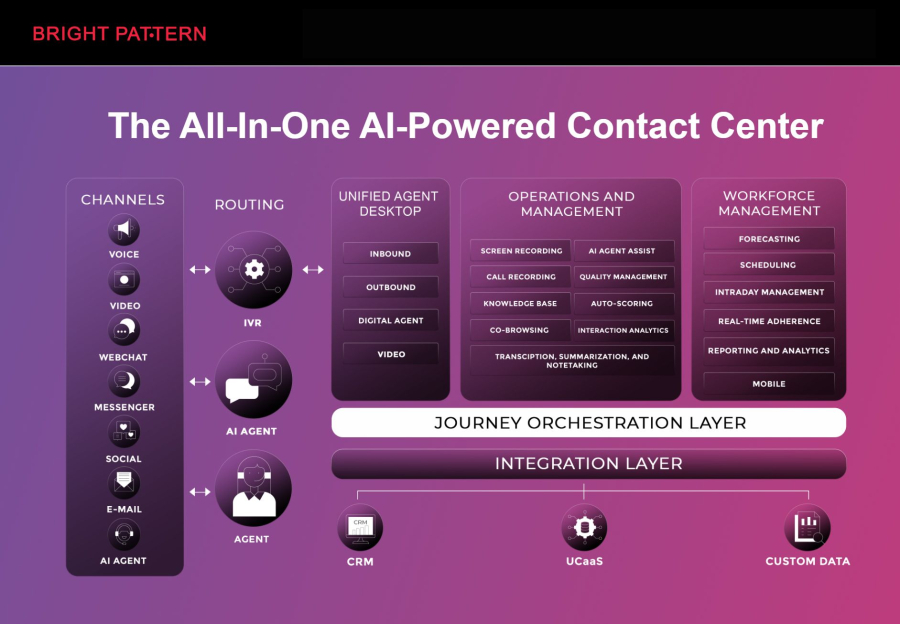
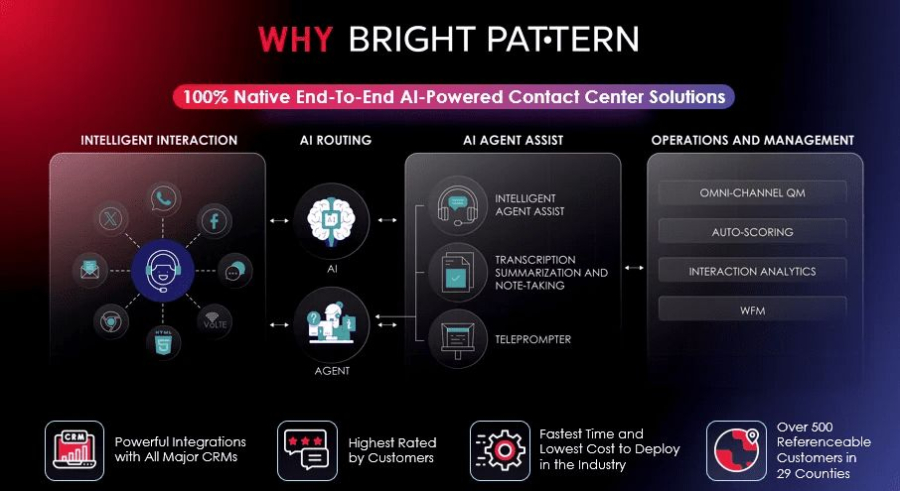
Bright Pattern leads the market with a comprehensive cloud-based AI contact center platform designed for omnichannel customer engagement. Their solution integrates advanced conversational AI examples to help businesses handle calls, chats, SMS, email, and social messaging seamlessly. Companies using Bright Pattern can optimize workflows, increase agent productivity, and deliver faster resolutions.
Key features include:
- Omnichannel routing with AI-assisted prioritization
- Smart virtual agents for automating routine queries
- Analytics dashboards for monitoring performance in real-time
- Integration with CRM systems for context-rich interactions
- Automated workflow management for call and chat escalation
By combining these features, Bright Pattern enables businesses to implement smarter, more efficient contact center operations while creating a natural, seamless experience for users.
2. Genesys Cloud
Genesys Cloud provides AI-driven contact center solutions that enhance conversational experiences across multiple channels. Their platform offers predictive routing, virtual assistants, and robust reporting tools to optimize agent efficiency and customer satisfaction.
3. Cisco Contact Center AI
Cisco’s solution integrates AI chatbots and voice assistants into call center workflows. It helps reduce wait times, streamline ticket resolution, and provides actionable insights into customer interactions.
4. NICE inContact CXone
NICE inContact CXone uses AI to analyze customer sentiment, automate responses, and support agents with real-time suggestions. It’s designed to deliver consistent, personalized experiences across all communication channels.
5. Talkdesk AI
Talkdesk AI leverages machine learning and natural language processing to automate routine customer queries, assist agents in real-time, and improve overall contact center efficiency.
6. RingCentral Contact Center
RingCentral offers AI-powered call center solutions that focus on predictive engagement, real-time analytics, and intelligent routing to optimize both customer and agent experiences.
7. 8x8 Contact Center AI
8x8 combines AI voice assistants and chatbots with omnichannel analytics. Their solution helps businesses enhance call handling, reduce agent load, and improve service quality.
8. Avaya OneCloud CCaaS
Avaya OneCloud CCaaS integrates AI conversational assistants into cloud contact centers, allowing for automated workflows, advanced routing, and performance monitoring to support scalable operations.
9. Mitel MiContact Center
Mitel’s AI-enhanced contact center provides conversational virtual agents, intelligent call distribution, and analytics tools to help organizations deliver faster, more efficient support.
10. LivePerson AI Contact Center
LivePerson focuses on conversational AI examples to provide messaging-first experiences. Their platform allows businesses to engage with customers proactively using chatbots and AI-powered messaging flows.
1. Customer Service Chatbots on Websites
When most people think of conversational AI, they imagine a website chatbot. Modern versions are far more capable than the old scripted bots that only understood a handful of keywords.
Today, customer service chatbots can:
- Understand natural language questions instead of just fixed menu options.
- Pull answers from knowledge bases, FAQs, and policy documents in real time.
- Handle common support flows end to end, like order status, returns, and appointment changes.
- Escalate smoothly to human agents with full context when needed.
Benefits for businessesinclude:
- 24/7 support without requiring round-the-clock staffing.
- Shorter queues for live agents, who can focus on complex issues.
- More consistent answers than manually searching knowledge articles.
- Lower average handling time, because the bot collects information upfront.
For customers, the biggest win is instant responses and self-service for routine questions, without needing to wait on hold or search through dense help pages.
2. Conversational AI in Messaging Apps
Customers increasingly prefer to talk with brands where they already spend their time: in messaging apps. Conversational AI can power automated assistants inside channels such as SMS and business messaging platforms.
Common use cases include:
- Order updates and delivery notifications with follow-up questions handled by the bot.
- Service reminders, like appointments, with simple reschedule flows.
- Quick troubleshooting via chat, including collecting photos or videos for context.
- Loyalty program interactions, such as checking points or redeeming rewards.
Why this works so well: messaging feels natural and low-friction. Users do not need to log in to a separate portal or download an app. The AI assistant can maintain a persistent conversation history, so customers can pick up right where they left off.
3. Voice Assistants for Customer Support
Conversational AI is not only about text. Voice-based virtual agents now answer calls, understand free-form speech, and respond with natural-sounding synthesized voices.
Typical scenarios include:
- Phone-based self-service for account balances, billing questions, and basic troubleshooting.
- Routing calls to the right human agent based on caller intent rather than rigid menus.
- Collecting information before the handoff, so agents join the call fully briefed.
These voice systems use speech recognition to interpret what callers say, natural language understanding to detect intent, and text-to-speech to reply.
Business impact: organizations can handle higher call volumes without proportionally increasing staffing, reduce average wait times, and provide more personalized, context-aware experiences.
4. AI Sales Assistants and Lead Qualification
Sales teams increasingly rely on conversational AI as a digital pre-sales assistant. These bots warm up leads, ask qualifying questions, and book meetings, all before a sales rep gets involved.
Example workflows include:
- Website visitors start a chat to learn about pricing; the AI asks about company size, use case, and urgency.
- Qualified leads are offered the option to book a demo in a rep's calendar instantly.
- Less qualified leads may be guided to self-service content, such as tutorials or comparison guides.
Some organizations also use AI to follow up on inbound leads via email or messaging, asking questions and nurturing interest over time.
Key benefits:
- Sales teams focus their time on high-intent, high-fit prospects.
- Lead response times shrink from hours or days to seconds.
- Every visitor gets a tailored experience, even outside business hours.
5. Onboarding and HR Assistants for Employees
Conversational AI is not just customer-facing. Many organizations deploy internal assistants that help employees with day-to-day questions and tasks.
In HR and people operations, conversational AI can:
- Answer common questions about benefits, vacation policies, and payroll.
- Guide new hires through onboarding workflows, paperwork, and required training.
- Help employees find internal documents or policies by asking in natural language.
- Support managers with quick access to performance review guidelines or checklists.
Rather than searching through multiple systems or emailing HR, employees simply ask the assistant.
Organizational benefitsinclude reduced HR inbox volume, faster onboarding, and a more consistent employee experience across locations and time zones.
6. IT Help Desk and Internal Support Bots
IT teams are another prime beneficiary of conversational AI. Internal support bots can handle repetitive questions and common incidents before they ever reach a human technician.
Practical examples:
- Resetting passwords or guiding users through multi-factor authentication setup.
- Helping employees install approved software or request access to a system.
- Walking users through troubleshooting for Wi‑Fi, VPN, or email issues.
- Automatically creating and classifying support tickets when human help is required.
These assistants often integrate with identity and ticketing systems. They can check user permissions, log incidents, and even trigger automated fixes where appropriate.
Result: IT staff spend less time on repetitive "how do I" questions and more time on high-impact projects, while employees get faster resolutions.
7. Conversational AI in E-Commerce and Retail
In e-commerce, conversational AI acts like a digital sales associate, guiding shoppers to the right products and removing friction from the buying journey.
Common use cases include:
- Product discovery: recommending items based on needs, preferences, or previous purchases.
- Size and fit guidance for apparel, using questions about body type and fit preferences.
- Cart recovery: reaching out to shoppers who abandoned a cart and answering objections.
- Post-purchase support: helping track packages, manage returns, and suggest complementary items.
Because conversational AI can tap into catalog data, reviews, and previous interactions, it can surface highly relevant recommendations without forcing users to navigate complex menus or filters.
Business outcomesoften include higher conversion rates, increased average order value, and fewer returns due to better product fit guidance.
8. Healthcare Triage and Patient Engagement Assistants
Healthcare organizations use conversational AI carefully, focusing on information, guidance, and logistics rather than diagnosis or treatment decisions. When designed responsibly, these assistants can significantly improve access and efficiency.
Example applications:
- Symptom checkers that help patients understand whether they should seek in‑person care, virtual care, or self-care.
- Appointment scheduling, rescheduling, and reminders through chat or voice.
- Pre-visit information collection, such as basic medical history and reason for visit.
- Medication reminders and follow-up questionnaires after procedures, supporting adherence to care plans.
When built with strong privacy and compliance controls, these systems can reduce call center pressure, help clinicians arrive better prepared, and make it easier for patients to stay on top of their care.
Important note: conversational AI in healthcare should support, not replace, qualified medical professionals. Clear disclaimers and human oversight are essential.
9. Education, Coaching, and Learning Companions
In education and training, conversational AI can act as a patient, always-available tutor or coach. This is valuable for both formal education and workplace learning.
Practical examples include:
- Study assistants that explain concepts, quiz learners, and adapt difficulty based on performance.
- Language learning partners that practice conversation, correct grammar, and suggest better phrasing.
- On-the-job training bots that answer "how do I do this" questions inside business tools.
Because conversational AI can provide instant feedback and adapt to the learner's pace, it keeps people engaged and reduces the friction of asking for help.
Benefits for organizationsinclude more scalable training programs, faster time to competence, and better support for self-directed learning.
10. Analytics, Reporting, and Data Q&A Assistants
Another powerful but sometimes overlooked example is the use of conversational AI as a front end for data. Instead of manually building reports, users can simply ask questions.
For instance, a manager might ask:
- "What were our sales by region last quarter?"
- "Show me the top products by revenue this month."
- "How does customer satisfaction this year compare to last year?"
The assistant interprets the question, queries the underlying data sources, and responds in natural language, often with charts or tables where supported by the interface.
Why this matters: it brings data access to non-technical users, reduces the backlog on analytics teams, and makes decision-making more real-time.
Quick Overview: Use Cases and Core Benefits
|
Use Case |
Primary Users |
Main Benefits |
|
Customer service chatbots |
Customers, support teams |
24/7 help, reduced queues, faster resolutions |
|
Messaging and voice assistants |
Customers, contact centers |
Meet users where they are, handle higher volumes |
|
Sales and lead qualification |
Prospects, sales teams |
Faster follow-up, better-qualified pipeline |
|
HR and onboarding bots |
Employees, HR teams |
Consistent answers, smoother onboarding |
|
IT help desk assistants |
Employees, IT teams |
Fewer tickets, quicker fixes |
|
E-commerce assistants |
Shoppers, retail teams |
Higher conversion, fewer returns, better discovery |
|
Healthcare assistants |
Patients, care teams |
Improved access, lighter admin load |
|
Learning companions |
Students, employees |
Personalized practice, always-on help |
|
Data Q&A assistants |
Managers, analysts, teams |
Self-serve insights, faster decisions |
Designing Conversational AI That Actually Helps People
Across all of these examples, the most successful conversational AI systems share a few traits:
- Clear purpose: they solve specific, well-defined problems rather than trying to do everything.
- Easy handoff to humans: when the AI reaches its limits, it gracefully connects users to real people.
- Access to the right data: they are integrated with internal systems, so they can actually perform actions, not just answer questions.
- Continuous improvement: teams review conversations, refine intents, and update knowledge regularly.
- Transparent boundaries: users know they are talking to an AI and understand what it can and cannot do.
When those ingredients are in place, conversational AI feels less like a novelty and more like a reliable digital teammate that improves over time.
How to Identify Your Best First Use Case
If you are considering conversational AI, you do not need to start with a massive, organization-wide rollout. Instead, look for:
- Questions your team answers over and over again.
- Processes with clear rules that do not require deep judgment.
- High-volume touchpoints where delays create frustration, like support queues.
- Areas where customers or employees struggle to find information on their own.
Pick one or two high-impact scenarios, design a focused assistant for those, and measure results. From there, you can expand into other use cases like the examples in this guide.
Bringing These Conversational AI Examples to Life
Conversational AI is no longer experimental. Across customer service, sales, HR, IT, healthcare, education, and analytics, it is quietly reshaping how people interact with organizations every day.
By starting with a concrete problem, grounding your assistant in accurate data, and keeping humans in the loop, you can turn these examples into real-world wins: faster answers, happier users, and leaner, more responsive operations.
The opportunity is not just to automate conversations, but to create experiences that feel more human, more helpful, and more accessible than ever before.
